Most of the damage people bring into a salon did not happen in a salon. It happened in the three weeks afterwards, usually because a set was left on too long or taken off the wrong way.
This is the part of the cycle nobody explains properly.
When to come back
For an overlay or extension set, two to three weeks is the usual window. What drives it is not the colour failing but the regrowth gap at the base of the nail.
That gap matters for a practical reason. As the set grows out, the balance point of the nail moves forward, and the leverage on the free edge increases. A set left well past its window is more likely to catch and tear, and a tear at that stage takes natural nail with it.
Overlay or infill with us is $60.
Infill or start again?
An infill rebalances a set you already have. A fresh set starts over. The choice is usually made for you by the condition of what is already on.
An infill is normally fine when: the set is intact, there is no lifting at the edges, and you are happy with the shape and colour.
Starting again is the better call when: several nails have lifted, there is any discolouration under the product, the shape has drifted from what you wanted, or you are changing to a noticeably different colour.
If you are not sure, send a photo before you come and we will tell you honestly which one you need. It changes both the price and the time to allow.
Removal is a service, not a shortcut
The most expensive thing you can do to your nails is take a set off yourself. Peeling or picking removes layers of the nail plate along with the product, and those layers take months to grow back. The thin, bendy, peeling nails people arrive with are very often the result of two or three self-removals rather than the sets themselves.
Proper removal is priced openly: soft gel removal $15, hard gel removal $25.
Looking after the nail underneath
A few habits do most of the work.
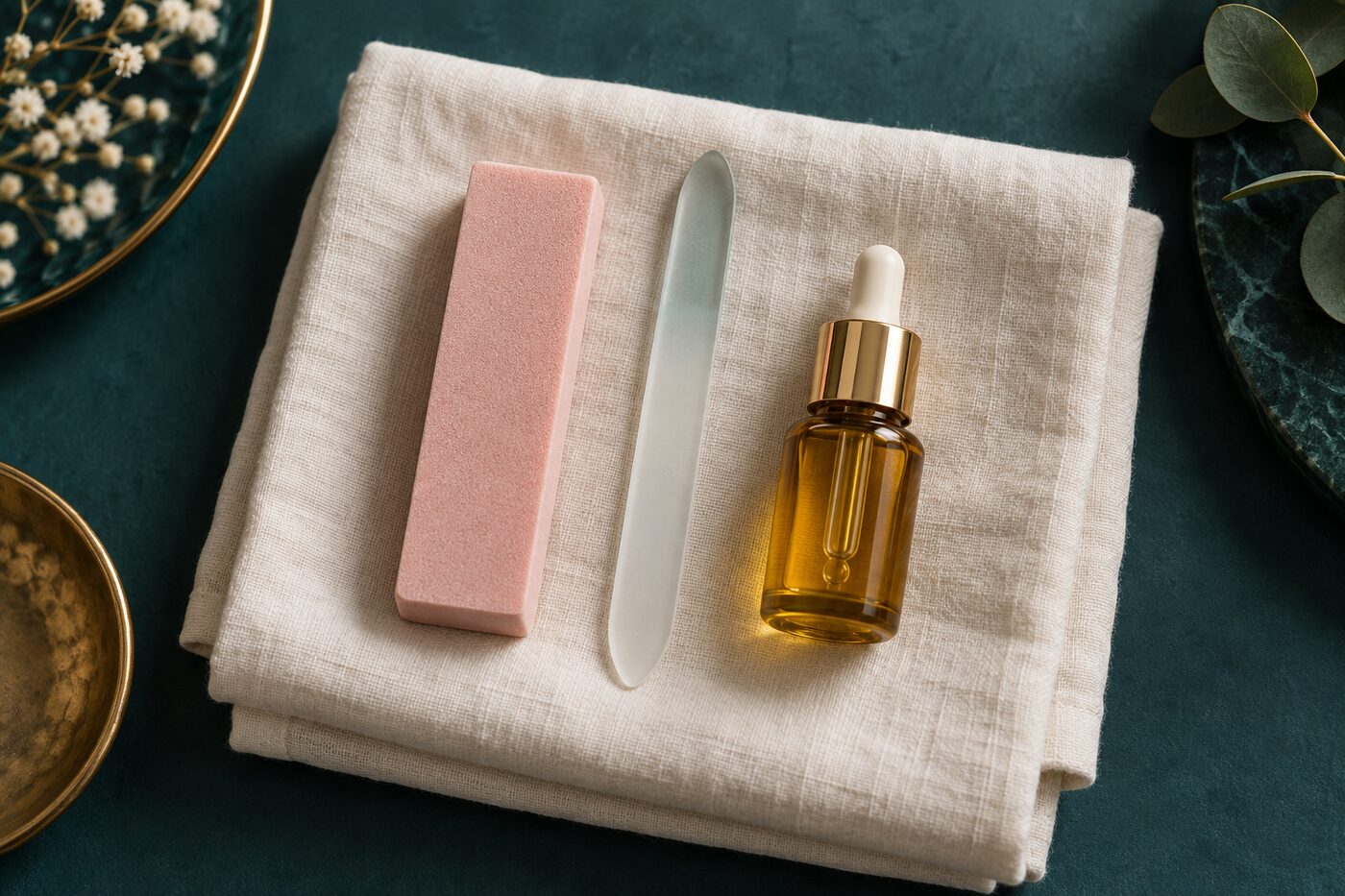
- Cuticle oil daily. The highest-return thing on this list. It keeps the surrounding skin flexible and reduces tearing at the base.
- Gloves for cleaning. Bleach and strong solvents dull a top coat and dry out the nail plate.
- Do not file a lifted edge flat yourself. It traps moisture under the product, which is how discolouration starts.
- Give it a break when it needs one. If your nails feel thin, a strengthening treatment is $25 and is a better use of a visit than another full set.
Singapore’s Health Sciences Authority publishes general guidance on cosmetic product safety if you want broader background reading.
When to ask rather than guess
Some things are worth a message rather than a wait. Any pain, persistent redness around the nail fold, a green or dark patch under the product, or a nail that has lifted away from the bed are all reasons to come in sooner rather than at your next scheduled appointment. A persistent nail or skin problem is a matter for a doctor rather than a nail technician, and we will say so if that is our read.
Building a routine that works
The cheapest set is not the one with the lowest price on the day. It is the one that does not cost you a recovery period afterwards. A maintained overlay at $60 every few weeks, with proper removal when you want a change, is usually less expensive over a year than repeated full sets on nails that never quite recover.
If you are still deciding which system suits you, start with gel, BIAB, acrylic or SNS. For aftercare that keeps a set on longer, read how to make a gel manicure last three full weeks. And if you are weighing up BIAB specifically, what BIAB costs and what you are paying for covers it.
Everything we offer is on the price list, and we are at #05-127A on Level 5 of Far East Plaza.